Feeds:
Posts
Comments

I’m working on my dissertation today (!), but I wanted to take a moment to thank my correspondents for reporting back to me with photos of things they’ve spotted in the wild.

Charlotte noted this creative dish on a menu:

And Royce has been busy on my behalf. Yesterday, he found this lovely sign (first contributed by Austin) in an antique store:

Today, he found that the devil really is in the details:

Thank you, Charlotte and Royce. And SIGH.

The following tweet and resulting class discussion prompted today’s post:

The discussion concerned the use of “dreamt.” Should he have used “dreamed” instead?

Both are correct, but “dreamed” is standard American, while “dreamt” is a British thing. So #Ross can use “dreamt” without raising an eyebrow, along with “regards,” “towards,” “spilt” and “learnt.” Americans drop that “s” in the former two and use the “ed” form in the latter two.

And that brings me to other “ed” issues.

  • The correct past tense of the verb “to plead” is “pleaded” (at least according to AP Style). Sorry “pled” lovers.
  • The preferred pronunciation of “striped” is “strEYEpt.” Fortunately for Claire, Merriam-Webster also allows “strEYE-ped.”
  • The most common pronunciation of “blessed” is “BLESS-ed,” but Merriam allows the one syllable variant as well. It depends on how you use it. One syllable for “I’ve been blessed with a generally even-keeled demeanor, even in the face of perceived classroom disrespect” and two for a use such as “I never get one blessed moment of peace at home.”

And by the way, I have never brought any Starburst candy for class — laced with drugs or not.

Spring flavor

What I have not been doing lately:

  • Working on my dissertation. (Explanation needs to be a separate post.)
  • Posting new content to this blog. (Clearly. It’s been 10 days!)
  • Worrying about anything. (Very much a good thing.)

What I have been doing:

  • Enjoying the “incubation” period where I consider how to continue with my dissertation.
  • Taking a break from the computer (e-mail, Facebook, Twitter, etc.).
  • Battling early-onset spring fever.

My spring fever manifests itself in strange ways. For example, I decided last week that I really wanted to make ravioli. From scratch. Filled with fresh lobster meat.

“What the f—?!” Eddie said. (But not in a negative way, of course.)

I bought a pasta maker and commenced pasta making.

Step 1: Make dough, knead and let it rest for 30 minutes.

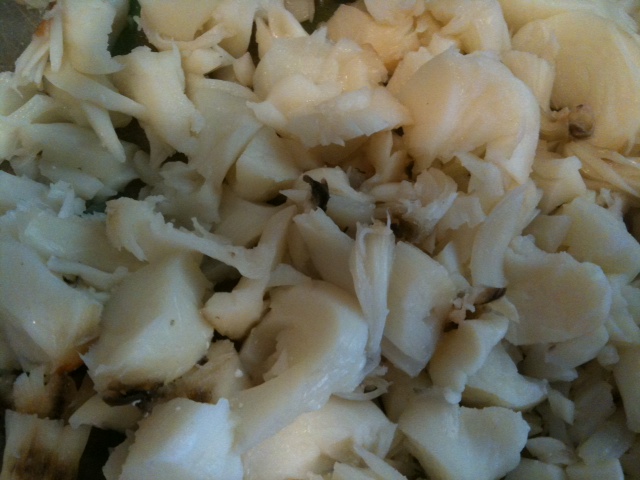
Step 2: Cook lobster. Chop tail (below). Mix with chopped mushrooms, salt, pepper and light cream.

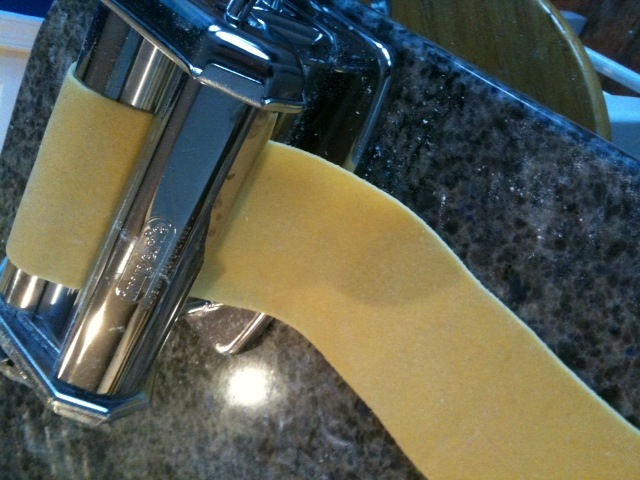
Step 3: Roll out dough in pasta maker.

Step 4: Use ravioli press to create pockets of joy. Repeat many times.

Step 5: Let ravioli dry for an hour on each side.

Step 6: Boil for eight minutes.

Step 7. Make garlic cream sauce in which to immerse ravioli.

Step 8: Top with chopped basil for that impressive restaurant flair.

Step 9: Gorge until you have to go lie down.

Family and friends = fat and happy (and totally impressed).

After that experience, I decided to experiment. I made spinach dough, which I turned into ground turkey and mushroom ravioli and also linguine.

And it’s only February.


I love that WordPress lets me know how people find my blog via search engines. For example:

My posts about the annual Redneck Games, Flamin’ Hot Cheetos, and rhetorical devices get the most visitors from search engines. Interesting.

I talked to Trish yesterday about following up our Redneck Games extravaganza with the annual Claxton Rattlesnake Roundup next month. She claimed she put it on her calendar. Hmmm. I suspect I’ll have to hound her into submission.

I’ve got nothing to say today about the Cheetos. I have a pantry packed with Flamin’ goodness.

I’m not sure I’ve got much left to say about rhetorical devices. And that’s a device right there. Aporia (“Uh-POHR-ee-uh”) is the act of expressing real or simulated doubt.

Another one comes to mind because some friends and I have been talking about the musical “Hair.” (It has been 10 years since we — yes, I was in it — performed it at SCAD.)

Ain’t Got No” is an example of anaphora (“Uh-NAF-er-uh”) because each line begins with the same words.

Finally (for today), dialysis refers to weighing two arguments as a choice: either/or, this/not that, no/yes, etc. For example, I had a Twitter spat with some woman in Atlanta who objected to what I said about Glenn Beck:


So, according to nautilus55, EITHER I like Glenn Beck, OR I am a liberal. No room for anything else there, I guess. And that’s a false dilemma, my friends, which is a logical fallacy. More about those some other time …


Chicken run

Jeanne is doing fine; thank you to those who asked about her well-being. She has been laying about five eggs per week. Jeanne and I have formed a close bond, and she comes running when I call her (like Trish used to). She likes me. Right now, she likes me!

Eddie? Not so much.

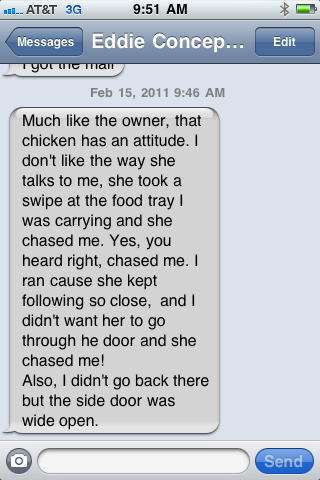
Jeanne has been pecking at the window screen on the side of our house, making Eddie angry. I asked him to feed her this morning, and this is the text message I received:

Yes, my 6-foot-4-inch tall husband ran from the chicken. Ha!

Post-conference stress disorder

You could say I was shell-shocked by the AWP conference I attended. I felt incapable of explaining my dismay. Hence the reason for such silence on this blog.

I’ve been back for four days, so here is my attempt.

If you want to party like it is 1989, then the conference is your kind of place.

  1. Some of the clothing, hairstyles and self-promotional styles were reminiscent of the “Me Decade.”
  2. Some of the music at the opening night reception came from the ’80s, as did the dancing style. (This video shows lots of white people dancing, but fails to capture some of their attempts at breakdancing. I’m very sorry I couldn’t get that on video.)
  3. Finally — and this is the really frightening aspect — out of about 350 panel discussions and workshops, fewer than 10 had anything — anything at all — to do with the magical world that is the Internet.

Really? I couldn’t believe it. I left the conference feeling like I had just met a herd of ostriches busy burying their heads in the sand. (Note: Ostriches do not actually bury their heads in the sand. I’m using the common metaphor.)

Print is not dead, but many writers are too busy lamenting the decline of the traditional medium to embrace the opportunities inherent in our digital age.

During a break from the conference, I also read a blog post by Nicholas Carr wherein he groused about the state of our collective attention span.

We’re shrinking our definition of long-form writing to fit the limits of our ever more distracted reading habits. What would have once been considered a remark is now considered a “short take”; what would once have been considered a “short take” is now a “middle take”; and what once would have been considered a “middle take” is now seen as a “long take.”

Yes,  in the “old days,” rich, white, middle-aged men would curl up by the fire and read Charles Darwin’s latest tome in preparation for a lively discussion with their rich, white, middle-aged male friends. (Those were pretty much the only people who were educated back then.)

Things are different now. Different expectations, realities, opportunities. There is a time and a place and a need for “long form” work, just as there is for “short form.” Accept it and move on. Bellyaching is not going to make the Internet go away.

Maybe that will be the title of the panel discussion I will propose to present at the AWP conference in 2012.

Wish me luck!

Keep calm and carry on

Ironically, when I am under the most stress, that is when I feel the most charitable toward fellow humans. I’m a kinder, gentler Beth (or “Betty,” as I am called by Dominic’s classmate’s mom).

Evidence:

  • I did not mentally resolve to fail the student who asked me (via Twitter) if we were having class today, despite the fact that I told him in person and via the syllabus that there was no class today.
  • I did not launch a well-placed kick at the nut sack of the idiot whose meandering while chatting on his cell phone nearly made us miss the train from the airport.
  • I did not body-slam the intellectual giant who thought it was a good idea to drag her suitcase — in which one could hide at least two corpulent corpses — onto said train, banging into everyone in sight and running over countless toes.

See?! I am calm. I. Am. Calm.

For those who wish to know, I am in Washington, D.C., attending the Association of Writers and Writing Programs annual conference.

Words for the week (weak?)

Writing a dissertation is a marathon, not a sprint. For me, it is a marathon that also includes deviations off the path to experience some waterboarding, flaying and pillorying.

There is a special place in hell reserved for the people who devise the rules, regulations and procedures governing thesis projects and dissertations at state universities.

But enough about that. I have plenty of time to complain about the dissertation process over the next three months. Let’s talk about something fun — like words that I love.

Hobo
This is a great word I’ve managed to use twice this week. I imagine plenty of stubble, patches, and a stick holding belongings tied in a kerchief — the whole nine yards.

Raggedy
Straight up to’ up. I also like “rickety.”

Ghastly
I use it when “horrible” just won’t do.

Barf
Succinct and illustrative.

Sycophant
It says so much more than “brown-noser” or “flatterer” could. I’ve only used this once this week, but there’s still time.

Hmmm … I see a theme emerging. Must be my general mental state. See first two sentences.

So today is apparently a big day for American football fans. In my world, here is how I remember who is still a contender:

Game 1:

The team immortalized by Chris Farley and some other folks in a “Saturday Night Live” skit vs. The team formerly led by the is-he-retiring-is-he-not guy who supposedly texted photos of his naughty bits.

Bit players won.

Game 2:

The team that used to have great players like my sixth-grade teacher’s husband’s cousin (John Stallworth) but is now led by an alleged pervert/assaulter vs. The Jets (as opposed to the Sharks).

Eddie likes the Jets, but, as I am writing this, a flock of geese evidently flew into their engines and they are making an emergency landing.

I sort of cared about the playoffs when the Falcons were still in it. Now I don’t care at all. But I’m still excited about the Super Bowl.

Why?

Commercials, people!

And this year’s Super Bowl coincides with the fact that I am teaching Promotional Writing where I get to talk about advertising. So I’m very excited.

And there’s the food, of course. It’s like the holidays where you give yourself a pass. I’m giving myself a pass to make myself sick on nachos while watching some double-perv action.

Yay, nachos!

The word for the day is “meh.”

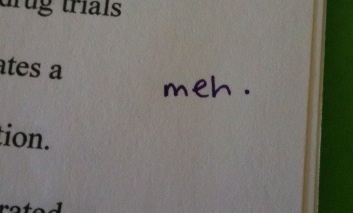
It is one of my favorite words, as students who have taken my classes will attest. I use it as an utterance in class, but also as a simple comment in the margin near a part of the submission I find less than stellar.

“Meh” beautifully conveys emotion — or rather, lack of emotion. It is a verbal shrug, a noncommittal answer, an indication of indifference.

It is the word for the day because my esteemed colleague Jonathan Rabb told me that one of our mutual students tried to use it in the narrative of a paper for his class. And then, when Jonathan balked, that person tried to justify it by citing me.

No, no, no. It can be used in a quote (“Meh,” she said). It can be used as a reaction (see above image). It can’t really be used in a narrative. It is akin to other interjections such as “Argh!” or “Rats!” (or even old-school Shaggy‘s “Zoinks!”) and has to be treated as such. Yes, even though it is now included in some dictionaries. Read this article for more on the origin and status of the word. (Note: I would put quotation marks around the word as it is used in the dictionary’s example.)

Despite its limitations, I think it is a lovely word that says so much with so little. I would like to celebrate the word by wearing this:

So, it is fair to say that I don’t feel “meh” about “meh.”