Feeds:
Posts
Comments

Posts Tagged ‘Definitions’

I love so many disease names. I’m very interested in medical things in general. “Trauma: Life in the ER” is a great show. Definitions courtesy of Merriam-Webster.

Scurvy: a disease caused by a lack of vitamin C and characterized by spongy gums, loosening of the teeth, and a bleeding into the skin and mucous membranes
It makes me feel like a pirate when I get a chance to say it.
Example: It looks like Austin has a bad case of scurvy.

Narcolepsy: a condition characterized by brief attacks of deep sleep often occurring with cataplexy and hypnagogic hallucinations
I also like “narcoleptic.”
Example: The professor worried that Daniel had narcolepsy.

Scabies: contagious itch or mange especially with exudative crusts that is caused by parasitic mites (especially Sarcoptes scabiei)
You don’t really hear about cases of scabies very much. That’s too bad. I really like the word.
Example: Charlotte woke up the next day with a hangover, scabies, and a guy named Nate.

Rabies: an acute virus of the nervous system of mammals that is caused by a rhabdovirus (species Rabies virus of the genus Lyssavirus) usually transmitted through the bite of a rabid animal and that is characterized typically by increased salivation, abnormal behavior, and eventual paralysis and death when untreated
Similar to scabies in that I really like the sound of the word. I also like “rabid.”
Example: “Now I’ll get rabies!” Jenny screamed after she was attacked by a rabid weasel.

Chickenpox: an acute contagious disease, especially of children, marked by low-grade fever and formation of vesicles and caused by a herpesvirus
It has nothing to do with chickens. The virus hangs out and can later cause shingles.
Example: Becca was convinced her daughter had chickenpox.

Leprosy: a chronic infectious disease caused by a mycobacterium affecting especially the skin and peripheral nerves and characterized by the formation of nodules or macules that enlarge and spread accompanied by loss of sensation with eventual paralysis, wasting of muscle, and production of deformities
You just don’t hear much about leprosy anymore. I also love the word “leper.”
Example: Kristine felt like a leper as she endured the bachelorette party at Deja Groove.

Gingivitis: inflammation of the gums
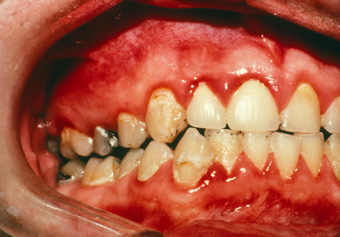
It’s just a fancy way of saying, “Yuck! You need to brush your teeth more often!”
Example: As soon as he opened his mouth and Elisa noticed his acute gingivitis, the blind date was over.

Halitosis: a condition of having fetid breath
If I like “gingivitis,” you know “halitosis” can’t be far behind. I also like “fetid.”
Example: Andrea could smell Elisa’s date’s halitosis before he even spoke.

Angina: a disease marked by spasmodic attacks of intense suffocative pain
It sounds a bit saucy, but it is not.
Example: Cameron claimed she had an angina attack to get out of the ad workshop.

Fasciitis: inflammation of a fascia (as from infection or injury)
It is just fun to say (though clearly not to have).
Example: Eddie had to wear a special boot to cure his plantar fasciitis.

As a side note, my favorite drug name is Boniva
(for osteoporosis).
Read Full Post »

I’ve mentioned words I hate in a number of posts. Lest you think I am a negative person — a hater, if you will — I have compiled a list of words I love (definitions courtesy of dictionary.com). Here they are, in no particular order:

Moist (adjective): Moderately or slightly wet; damp
People either love this word or hate it. I love it because I think it really conveys that clammy quality.
Example: I shook his moist, limp hand, and instantly regretted it.

Egregious (adjective): extraordinary in some bad way; glaring; flagrant
The word just rolls off the tongue (or off the fingers, as the case may be).
Example: The professor wrote, “I will take off five points for each egregious error I find.”

Heinous (adjective): hateful; odious
Like egregious, it is just a good, all-purpose adjective to convey something unpleasant.
Example: Trish’s attitude swings from lovely to heinous — sometimes within minutes.

Beastly (adjective): nasty; unpleasant; disagreeable
See “egregious” and “heinous.”
Example: The humidity in Savannah is quite beastly in August.

Harass (verb): to disturb persistently; pester
Up until recently, this word was pronounced “HAIR-uhs” (and still is in many places). Here in America, we commonly say “huh-RASS,” which I like better because it is stronger (and I get to say “ass”).
Example: “Gideon, stop harassing the dog!” Eddie said.

Jackass (noun): a contemptibly foolish or stupid person
Speaking of ass, “jackass” is also a great word. It is strong, succinct, and also employs the word “ass.”
Example: People who leave anonymous comments on blogs are just jackasses.

Badger (verb): to harass
It is just such a great, descriptive verb.
Example: Dominic would not stop badgering his mother about his Batman suit.

Meh (interjection): expression of apathy or indifference
Nothing says indifference quite like “meh.” Just ask students in my classes.
Example: She asked, “Professor, how do you feel about my paper topic?” “Meh,” I replied.


Rascal (noun): a mischievous person or animal
I think I might have stolen this word from Eddie. I’m a rascal.
Example: Eddie looked at our wedding picture and said, “Who’s that handsome rascal?”


Hillbilly (noun): a person from a backwoods or other remote area
The word conjures up so many fantastic images.
Example: Effingham County is populated with hillbillies; Chatham County is populated with hillbillies who have money.

I see a theme here. I promise I also like words that convey positive things. But that is for another post.

Read Full Post »

Shane Marshall Brown, He Who Has Three Names, sent to me a link to a New York Times article about self-appointed Twitter scolds. I love it.

Even though I usually give people a pass for Facebook and Twitter, I’m happy to see others carrying the torch for proper grammar and punctuation.

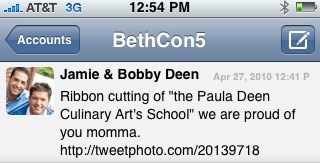
I wonder if they noticed the Deen Brothers’ tweet with the incorrect apostrophe:

Meanwhile, I’m still busy with loathsome words such as “partner.” Here it is, offending me from behind a glass enclosure at Memorial Health University Medical Center.

Why can’t they just join Memorial? Or be listed as co-sponsors? Or just have the logos without text? Sigh.

Read Full Post »

As soon as I posted the list of the top five words I hate, I knew I would have a sequel. Here are five more words/phrases:

In order to
Like “currently,” this is unnecessary. “To” works just as well by itself.
Incorrect: In order to get his yard work done, Eddie had to take off a day of work.
Correct: Eddie had to take a vacation day to finish the yard work.

Piqued
I don’t hate this word. I hate that people don’t know how to use it correctly. People often spell it “peaked” or “peeked.” But it is a French word derived from “piquer,” which means “to prick.”
Incorrect: A student peaked my interest in peopleofwalmart.com
Correct: A student also piqued my curiosity about textsfromlastnight.com.

Hors d’oeuvres
This is another French word that I like when used correctly. The trouble is that people want to use it, but don’t know how to spell. It means “out of the main work,” and refers to appetizers. People mangle the “oeuvre” in a variety of ways, including “ourve.” One enterprising student wrote it “orderves.” Either write “appetizers” or look it up.

Biweekly
Is it every two weeks or twice a week? “Biweekly” can mean either. I hate the ambiguity. AP Style uses “biweekly” to mean “every other week,” and “semiweekly” to mean “twice a week.” But not everyone uses it that way. So let’s be specific.
Incorrect: He updated his blog biweekly.
Correct: He only updated his blog every other week.

PIN number
“PIN” stands for “personal identification number,” so “PIN number” would mean “personal identification number number.” And that’s silly. Same with “VIN number” (vehicle identification number number) and “UPC code” (universal product code code).
Incorrect: Give me your PIN number so I can steal your money.
Correct: “Give me your PIN,” I said.

I’m probably not done yet with the “words I hate” topic. People subject English to so much butchering.

Read Full Post »

Some students in my classes have asked for a list of words I hate. Here are the ones that are always at the top:

Currently

If there is a verb in the sentence, then you don’t need that adverb. It is redundant.

Incorrect: Beth is currently a writing professor. “Is” means it is happening right now. “Currently” is overkill.

Correct: I can’t think of an occasion where you would need it.

Hopefully

This is one of the most misused words in the English language. People use it to mean “I hope.” If that is what you mean, then use, “I hope,” for Pete’s sake! It is an adverb, which means it needs to modify a verb.

Incorrect: Hopefully, the envelope contains a bonus check. How is the envelope behaving in a hopeful manner?

Correct: She looked hopefully at the envelope, convinced that it contained a bonus check.

Utilize

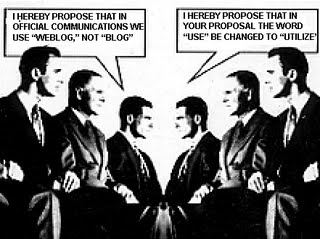
I’ve mentioned it before, but it bears repeating: There is nothing wrong with the word “use.”

Incorrect: Utilize your knowledge of grammar to start a blog.

Correct: Use your knowledge of grammar to start a blog. See? “Use” is a perfectly good word.

Nauseous

People use this word to mean “I am sick to my stomach.” But what they should say is “nauseated” because that is what they are. If they are nauseous, then they cause nausea in others.

Incorrect: “I’m nauseous now,” said Eddie after riding The Flying Critter at the fair.

Correct: “The Flying Critter made me nauseated,” he said.

Partner

This is a noun, not a verb. Stop trying to “partner” with people, and just team up, join them or just combine completely in the sentence.

Incorrect: The SCAD writing department is partnering with the graduate studies department to present a lecture by Rebecca Skloot.

Correct: The writing and graduate studies departments are sponsoring the lecture.

There’s more, but this list has made me nauseated, and I need to lie down.

Read Full Post »

It seems so idyllic: A mother helps her young children color eggs for Easter. And this is a happy-looking scene:

The reality is that this was one of the only peaceful moments. For 95 percent of the afternoon, it was a cacophony.

“Mama! He’s got my crayon!”

“I wanted the blue!”

“Get your egg out of there!”

“Stop slinging the dye!” (OK, that was me.)

And I also had to explain what the Easter Bunny has to do with Jesus. Like Christmas, Easter is a holiday of mixed messages: “Eat candy and think about Jesus.” Kids are right: It doesn’t make any sense. But as adults, we kind of go along with it.

I wasn’t going to give them Easter baskets because my kids don’t need candy. Don’t say, “Aww, that’s mean,” unless you know them. And if you know them, you wouldn’t say it. I caved and made small ones for them. Shortly after they hunted those slimy eggs and tore into the baskets, I regretted my decision. Their shrieks nearly made my ears bleed and their playroom looked like a Toys R Us had exploded.

I may have gone a little berserk. I may have smashed one of their toy guitars like I was Pete Townshend. I may not invite the Easter Bunny over again.

Read Full Post »

I just read a newsletter that featured the word “complementary” (an accompaniment) when the writer really meant “complimentary” (free or offering praise). Many people have a problem with those words, and other homonyms. So let me explain.

Homonym: umbrella category for words that sound the same or are spelled the same.

Fuzzy Wuzzy (Wuz a Bear)Homograph: words that are spelled the same and sometimes sound the same, but have different meanings

Examples: bear (to carry)/bear (Fuzzy Wuzzy)  and wind (air)/wind (crank)

Homophone: words that sound the same, may be spelled the same, but have different meanings

Examples: they’re/their/there and you’re/your and bear/bear from above. Bear/bear is a homophone and a homograph.

Easy way to remember:

HOMO (same) + PHONE (sound) and HOMO (same) + GRAPH (writing)

OK, now it might get confusing. Also under the homonym umbrella are heteronym and heterograph.

Heteronym: words that are spelled the same, but have different pronunciations and meanings. Notice this is the same definition as “homograph.” “Heteronym” is a subset of “homograph,” which is a subset of “homonym.” Heteronyms are always pronounced differently.

Example: wind (air)/wind (crank) — this is both a homograph and a heteronym

Heterograph: pronounced the same, but spelled differently. Notice this is the same definition as “homophone.””Heterograph” is a subset of “homophone,” which is a subset of “homonym.” Heterographs always have different spellings and meanings.

Example: you (gentle reader)/ewe (lady sheep) and bare (nekkid)/bear (aforementioned Fuzzy).

Luckily, there is no such thing as a heterophone to confuse the matter any further.

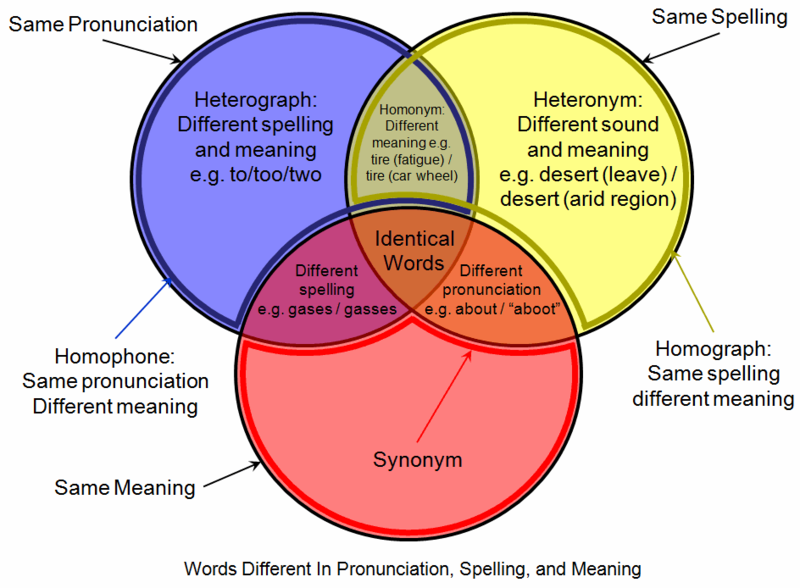
Here’s a Venn diagram of the above for you visual folks.

Venn diagram by Will Heltsley

The only problem is that the diagram makes it look like homonyms are only words that are both homophones and homographs. Homonyms are really the whole shebang.

And that’s different from “ad hominem,” which is a logical fallacy that is an argument against a person.

Sigh.

Read Full Post »

I’m not a fan of April Fool’s Day. I think I have a good sense of humor, but I don’t think pranks are funny.

If someone is going to be a fool, then I hope there is a camera around to capture it (I am the target audience for America’s Funniest Home Videos and the like).  But I don’t like pranks because I feel sorry for the victim, and it is really the prankster who looks the fool.

Maybe it is the role of the prankster to put life in perspective with humor, but this party pooper thinks there are better ways. Harumph.

Read Full Post »

Memorial Health University Medical Center has Wi-Fi, which is quite nice. You would think all hospitals would have it, but you’d be wrong. Because of my mom, dad and Eddie, I’ve sampled many hospitals.

Anyway, thanks to Memorial’s Wi-Fi, I’m able to write and upload this post. Eddie is having his third, and last (I hope), cardiac ablation today.

What’s that? Well, it is a procedure where a cardiologist (as opposed to a dermatologist, or someone who stayed at a Holiday Inn) threads a catheter into the heart and burns the crap out of the part of the heart that is causing it to beat irregularly. Read this for a more technical overview.

Eddie has had this procedure twice already, so I don’t know how much non-scarred tissue there is left. After each ablation, the doctor has said, “That should do it.” And it hasn’t. Yes, we got a second opinion. The second doctor just wanted to keep shocking Eddie’s heart back into rhythm, all “ER” style.

Anyway, here we are, at Memorial again, and hoping for the best.

Read Full Post »

I know I just wrote a new post, but then Caila, SCAD Radio‘s general manager, shared this with me:

Full link here.

Forget that the writer clearly doesn’t know AP Style. She has bigger issues. Evidence: the very first sentence. I’m guessing she meant “descend” not “decent.”

But wait, there’s more. Gaze upon this section:

So let’s help her out on the big ones:

  • “dies” should be “dyes”
  • “chanel” should be “channel”
  • “affect” should be “effect”

I love the “rumor vs. reality” theme, and I like her voice. What I don’t like, of course, is that it is riddled with mistakes she should have caught. And I’m guessing Savannah Morning News writers post directly to the Web without benefit of a copy editor’s glance.

SIGH.

Read Full Post »

« Newer Posts - Older Posts »