Feeds:
Posts
Comments

Posts Tagged ‘Media’

I may need to stop reading the paper. It’s not good for my blood pressure.

This time it is not because of a Savannah Morning News error, but rather an article that is printed on page 12A. It was a small piece, but it had a large effect on me.

Warning: If you are Catholic, or a pope supporter in general, you might want to stop reading now. I’m about to write some not-so-nice things about the pontiff.

According to the SMN article (The New York Times has a larger, better overview), Pope Benedict XVI told Catholic social workers, health providers and some others assembled for a Mass in Fatima, Portugal, that abortion and same-sex marriage were two of the most “insidious and dangerous” threats facing the world today.

Really? Happy gay people are a threat to the world?

Not child abuse? Really?

Ben, let’s talk. I know you are in a world of hurt trying to pretend that you don’t need to deal with your big, fat scandal, but you cannot throw us off the scent.

I know you don’t have kids, so you might not get it, but children are sponges. They soak up all the good and bad that they see, hear and feel. So if a bishop is letting his little bishop run free all over 10-year-old hide, there is a problem. And that is going to affect that child forever.

If you believe that killing children (even still as a fetus) is wrong, then how could you not see abuse as one of the biggest threats to the world? There are thousands and thousands of children who have been abused by priests and others in the Catholic Church and likely will suffer psychological, emotional and physical effects. According to the American Psychological Association, children who have been abused have an increased risk for:

  • Depression
  • Post-traumatic stress disorder
  • Dissociative and anxiety disorders
  • Eating disorders
  • Poor self-esteem
  • Somatization (the expression of distress in physical symptoms)
  • Chronic pain
  • Behavioral problems including sexualized behavior, school/learning problems, substance abuse, destructive behavior, sexual dysfunction in adulthood, criminality in adulthood
  • Suicide

Barbara E. Bogorad, Psy.D., founder and former director of the Sexual Abuse Recovery Program Unit of South Oaks Hospital in New York wrote:

Abused children are 53% more likely to be arrested as juveniles, and 38% more likely to be arrested for a violent crime. During preschool years, abused children are more likely to get angry, refuse direction from teachers, and lack enthusiasm. By the time they reach grade school, they are more prone to being easily distracted, lacking in self-control, and not well-liked by peers.

But it is same-sex marriage you choose to target as the problem?

Yes, there is a problem. And he is wearing a pointy hat.
Read Full Post »

The day of the mom

I feel about Mother’s Day the way I feel about Valentine’s Day: It is kind of a silly holiday. People should appreciate moms every day of the year, not just one magical day. But I’m not going to turn down a little extra love.

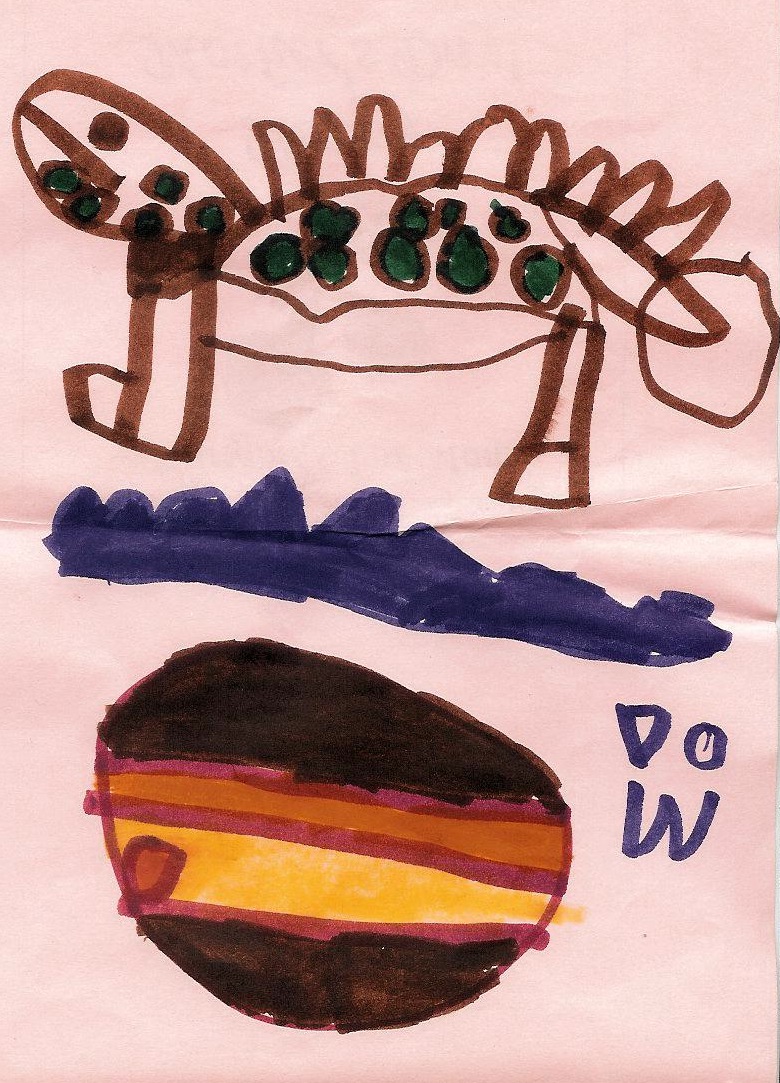
It is kind of cool when you have little kids, because you get the special craft projects. Dominic drew a card that featured two of his favorite things: Jupiter and a Euoplocephalus.

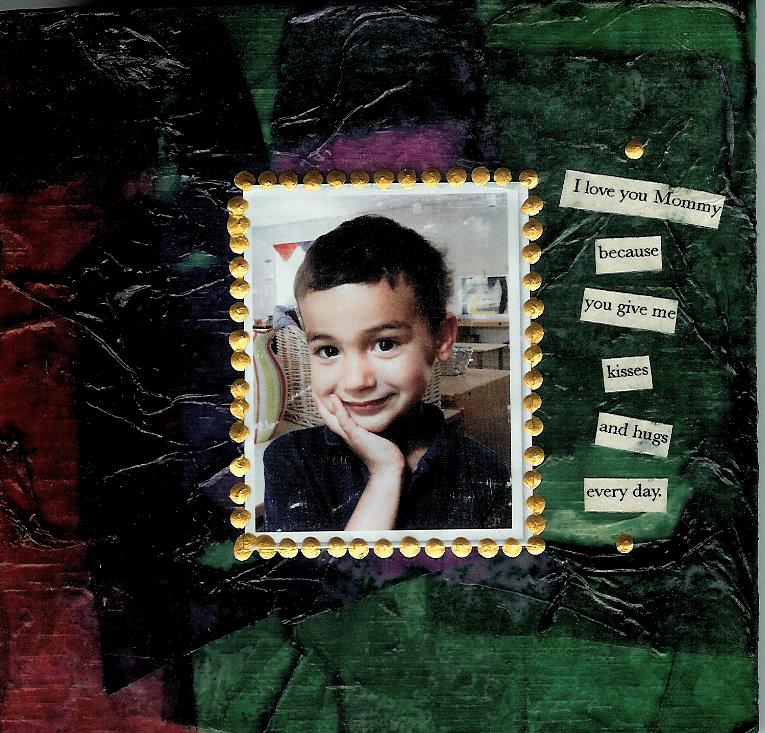
And how could I not love this plaque from Gideon?

Maybe Mother’s Day isn’t so silly after all.

(And her heart grew three sizes that day.)

Read Full Post »

Shane Marshall Brown, He Who Has Three Names, sent to me a link to a New York Times article about self-appointed Twitter scolds. I love it.

Even though I usually give people a pass for Facebook and Twitter, I’m happy to see others carrying the torch for proper grammar and punctuation.

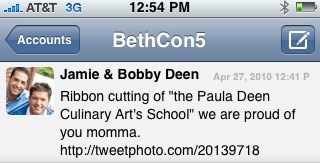
I wonder if they noticed the Deen Brothers’ tweet with the incorrect apostrophe:

Meanwhile, I’m still busy with loathsome words such as “partner.” Here it is, offending me from behind a glass enclosure at Memorial Health University Medical Center.

Why can’t they just join Memorial? Or be listed as co-sponsors? Or just have the logos without text? Sigh.

Read Full Post »

Some students in my classes have asked for a list of words I hate. Here are the ones that are always at the top:

Currently

If there is a verb in the sentence, then you don’t need that adverb. It is redundant.

Incorrect: Beth is currently a writing professor. “Is” means it is happening right now. “Currently” is overkill.

Correct: I can’t think of an occasion where you would need it.

Hopefully

This is one of the most misused words in the English language. People use it to mean “I hope.” If that is what you mean, then use, “I hope,” for Pete’s sake! It is an adverb, which means it needs to modify a verb.

Incorrect: Hopefully, the envelope contains a bonus check. How is the envelope behaving in a hopeful manner?

Correct: She looked hopefully at the envelope, convinced that it contained a bonus check.

Utilize

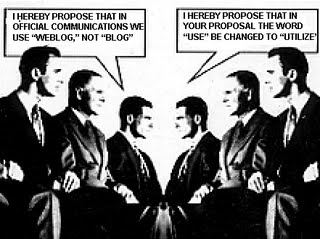
I’ve mentioned it before, but it bears repeating: There is nothing wrong with the word “use.”

Incorrect: Utilize your knowledge of grammar to start a blog.

Correct: Use your knowledge of grammar to start a blog. See? “Use” is a perfectly good word.

Nauseous

People use this word to mean “I am sick to my stomach.” But what they should say is “nauseated” because that is what they are. If they are nauseous, then they cause nausea in others.

Incorrect: “I’m nauseous now,” said Eddie after riding The Flying Critter at the fair.

Correct: “The Flying Critter made me nauseated,” he said.

Partner

This is a noun, not a verb. Stop trying to “partner” with people, and just team up, join them or just combine completely in the sentence.

Incorrect: The SCAD writing department is partnering with the graduate studies department to present a lecture by Rebecca Skloot.

Correct: The writing and graduate studies departments are sponsoring the lecture.

There’s more, but this list has made me nauseated, and I need to lie down.

Read Full Post »

I just read a newsletter that featured the word “complementary” (an accompaniment) when the writer really meant “complimentary” (free or offering praise). Many people have a problem with those words, and other homonyms. So let me explain.

Homonym: umbrella category for words that sound the same or are spelled the same.

Fuzzy Wuzzy (Wuz a Bear)Homograph: words that are spelled the same and sometimes sound the same, but have different meanings

Examples: bear (to carry)/bear (Fuzzy Wuzzy)  and wind (air)/wind (crank)

Homophone: words that sound the same, may be spelled the same, but have different meanings

Examples: they’re/their/there and you’re/your and bear/bear from above. Bear/bear is a homophone and a homograph.

Easy way to remember:

HOMO (same) + PHONE (sound) and HOMO (same) + GRAPH (writing)

OK, now it might get confusing. Also under the homonym umbrella are heteronym and heterograph.

Heteronym: words that are spelled the same, but have different pronunciations and meanings. Notice this is the same definition as “homograph.” “Heteronym” is a subset of “homograph,” which is a subset of “homonym.” Heteronyms are always pronounced differently.

Example: wind (air)/wind (crank) — this is both a homograph and a heteronym

Heterograph: pronounced the same, but spelled differently. Notice this is the same definition as “homophone.””Heterograph” is a subset of “homophone,” which is a subset of “homonym.” Heterographs always have different spellings and meanings.

Example: you (gentle reader)/ewe (lady sheep) and bare (nekkid)/bear (aforementioned Fuzzy).

Luckily, there is no such thing as a heterophone to confuse the matter any further.

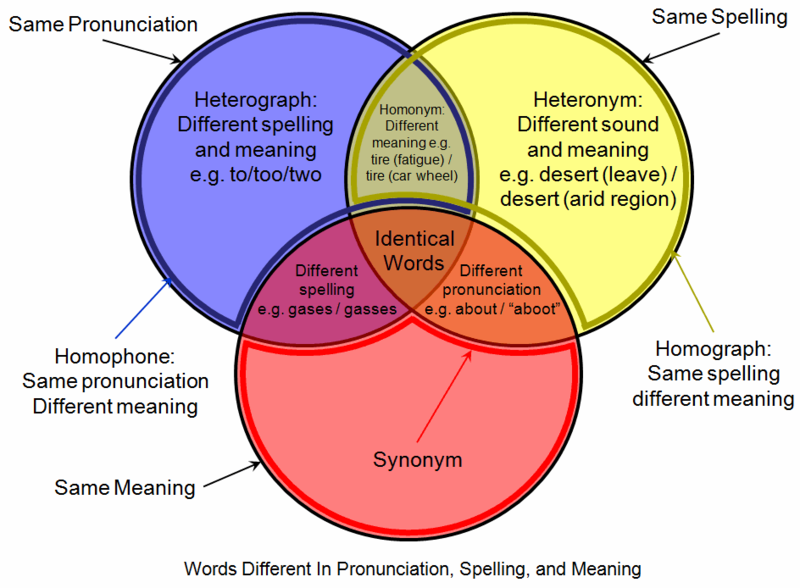
Here’s a Venn diagram of the above for you visual folks.

Venn diagram by Will Heltsley

The only problem is that the diagram makes it look like homonyms are only words that are both homophones and homographs. Homonyms are really the whole shebang.

And that’s different from “ad hominem,” which is a logical fallacy that is an argument against a person.

Sigh.

Read Full Post »

I know I just wrote a new post, but then Caila, SCAD Radio‘s general manager, shared this with me:

Full link here.

Forget that the writer clearly doesn’t know AP Style. She has bigger issues. Evidence: the very first sentence. I’m guessing she meant “descend” not “decent.”

But wait, there’s more. Gaze upon this section:

So let’s help her out on the big ones:

  • “dies” should be “dyes”
  • “chanel” should be “channel”
  • “affect” should be “effect”

I love the “rumor vs. reality” theme, and I like her voice. What I don’t like, of course, is that it is riddled with mistakes she should have caught. And I’m guessing Savannah Morning News writers post directly to the Web without benefit of a copy editor’s glance.

SIGH.

Read Full Post »

My niece, Nina, created a list of things soldiers need. For most of us in our comfortable homes in our comfortable lives, it is hard to image that the troops need such simple things. Get ye to Walgreens (I hear they give you a discount on purchases for soldiers)!

  • Robitussin (single dose, box of 10)
  • Hot hands (hand warmers)
  • Wisps (disposable tooth brushes)
  • Charmin travel rolls
  • Small compact mirror (for shaving)
  • Cough drops (with Vitamin C)
  • Protein bars (meal replacement)
  • Granola bars
  • Pop-Tarts
  • Mini bagels
  • Travel packs of tissue
s
  • Tuna in foil packaging (not canned)
  • SpaghettiOs, ravioli, etc., in pull-top containers
  • Instant mac and cheese
  • Ground coffee (Dunkin’ Donuts)
  • Pepto Bismol
  • Alka Seltzer
  • BC powder
  • Aleve
  • Immodium
  • Carmex lip balm
  • Medicated foot powder
  • Candy and gum
  • Ziploc bags
  • Salt and pepper
  • Sewing kits
  • Bengay
  • Beef jerky and summer sausage
  • Dried fruit
  • Gatorade or Propel (singles)
  • Instant drink mix
  • Eye drops
  • Hand sanitizer
  • Antibacterial wipes
  • Sunflower seeds
  • Trail mix
  • Deodorant
  • Mouthwash
  • Dental floss
  • Nail clippers
  • Socks
  • Dog food pouches (there are lots of stray dogs around)
  • Books and magazines

Remember: Happy and healthy troops can make progress and get home soon!

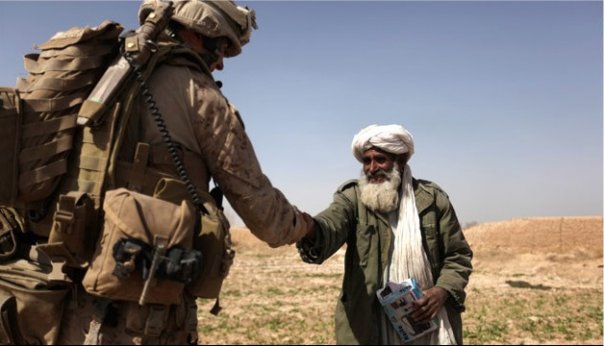
Lt. Mark Greenlief tries to make friends with the locals

Read Full Post »

“I” vs. “me” AGAIN

I’m not happy with the copy editor of today’s issue of the Savannah Morning News. In addition to allowing Arlinda Smith Broady to get away with using an ampersand in SCAD’s name on the front page of Exchange, the editor allowed an improper use of “I” on the front page of Accent. In a short about her new column, Christine Lucas wrote, “It’s just that he’s got my husband and I a little bit Rattled.” I’ll overlook the random capitalization because that could be a typo. The use of “I” however is ignorance. She shouldn’t have written it, but the copy editor should have caught it.

I don’t understand why this is so hard. As I explained in an earlier post, “I” is a subject pronoun and “me” is an object pronoun.

If you are doing something to someone or something, use “I” because you are the subject. If something is being done to you, use “me” because you are the object.

People incorrectly use “I” all the time. Why is “me” so frightening?

Eddie can’t stand watching television with me sometimes because I will mutter the correct version. And then sigh loudly.

So let’s go over it again. Here are some examples: Eddie and I are watching television. Dominic and Gideon watched television with Eddie and me. I said, “Dominic, give the remote to your father and me.” Eddie said, “Gideon, you and I are going upstairs right now because you can’t sit still.”

When in doubt, leave it out. Then see if the sentence makes sense. So Christine Lucas’ sentence without the other person would be, “It’s just that he’s got my husband and I a little bit Rattled.” That’s certainly not right. So use “me” instead: “It’s just that he’s got my husband and I me a little bit Rattled.” THAT makes sense. So the sentence should read, “It’s just that he’s got my husband and me a little bit Rattled.”

Copy editors should know these kinds of things. Now all of you do too.

Read Full Post »

In 2005, when SCAD was considering offering a writing major, I thought to myself, “Self, it would be great to teach in that department.” Though I had oodles of work experience, I knew that SCAD’s accrediting body prefers terminal degrees in the field of instruction. So I had two choices: Get another M.F.A. (the one I have is in performing arts) or get a Ph.D. I chose the latter.

I had three criteria in mind as I researched programs: areas of study offered (journalism or communications), proximity and reputation. The one that fulfilled all these requirements was University of South Carolina.

Eddie badgered me to apply. “But that would require taking the GRE!” I whined. “And I’m pregnant!”

“So?” he said, with very little compassion, I might add.

Lest you think he is heartless, his philosophy was that I might as well get on it while the kids were very young. That way I would be done when they got old enough to start extracurricular activities that I wouldn’t want to miss.

I knew he was right. I forced myself to take the GRE and apply to the doctoral program in the USC School of Journalism and Mass Communications. I was accepted, and began coursework Fall 2006. The total courses involved for most folks: 16 (48 semester hours). For me: 18 (because my master’s is not in the specific area).

I finished the coursework in April 2009. I spent the summer procrastinating on my dissertation proposal, and dreading the comprehensive exams (four days, three hours a day of answering questions in four areas: theory, methods, ethics and rhetoric, which is my outside area). I passed the foreign language proficiency test in October (see related post). The comps dread continued.

The time came, though, for me to put up or shut up. I studied my haunches off in preparation for the comps, which I stupidly scheduled for the week after Thanksgiving. The 19 people in my house for the holiday might not have fully understood why I was so stressed out.

Along with the written comps, there is an oral defense. That happened today. After my committee slowly roasted me over an open fire for two hours, they decreed that I had passed. To be honest, the first 20 minutes were horrendous, but then the rest was fine. The discussion will help me hone my dissertation proposal, for sure.

And that is the next step. I defend said proposal in front of my committee Feb. 19. Once I pass (the power of positive thinking), I will work exclusively on my own research for my dissertation. Then I will have to defend my dissertation in front of the same committee. Thumbs up, and my hooding awaits. Thumbs down, and … well, that’s really not an option for me.

So if I look a little frazzled in February (and over the summer), you’ll know why.

Read Full Post »

I rarely read for fun anymore because I don’t have time. People, Newsweek and Entertainment Weekly are my only sources of reading enjoyment. Sad, I know.

While I was in Barnes & Noble buying a book for research, I decided to buy “Columbine” by Dave Cullen because I had heard so many good things about it. I devoured it in less than 24 hours (kind of a long time for me, actually, but I had two vocal distractions and a “Survivor” finale to watch).

It is an impressively researched and incredibly interesting book. I remember the shootings, but was, like most, misled by erroneous and perpetuated media accounts into believing Eric Harris and Dylan Klebold were outcasts who were being bullied. Instead, Cullen makes clear, they often did the bullying, and they had few close friends by choice. At least that was Eric’s choice. He was a true psychopath, the clinical definition. Dylan was depressed, lonely and incredibly shy.

One of the concepts I teach is crisis communication. The Jefferson County sheriff and his office did almost everything wrong. Repeatedly. But, if nothing else, communicators can learn from their mistakes.

The overall feeling I have after reading the book is sadness — sadness for the victims and their families, of course, but they have long had support in their recovery and grief. I feel the most sadness for Tom and Sue Klebold and Wayne and Kathy Harris. It is easy to point the finger of “bad parenting” at them, but there is no “if/then” manual for parents. You have to do the best you can. It is hard to distinguish the difference between warning signs and normal teenage angst. And no one wants to think his/her child is a psychopath. They also lost their children on April 20, 1999, but their children were killers, which adds another layer of pain. They also lost community support and relationships. They were vilified unjustly.

In general, the book is a solid piece of reporting. I do wonder why he chose to focus on the stories of a few of the victims, but not all. Some are not even mentioned. Also, Cullen could have used a diagram of the building and images of the people he discusses, but perhaps he thought the images would sensationalize the story even more than it has been. But I wanted to be able to visualize whom he was discussing. I turned to the Internet, of course. The bullying myth is still rampant in the comments on the videos. I wanted to respond to all of them. Sigh. Maybe word will get around thanks to Cullen.

Now I’m off to play with the kids, and hope that one of them does not grow up to be infamous.

Read Full Post »

« Newer Posts - Older Posts »