Feeds:
Posts
Comments

Archive for the ‘Grammar, etc.’ Category

I’ve mentioned words I hate in a number of posts. Lest you think I am a negative person — a hater, if you will — I have compiled a list of words I love (definitions courtesy of dictionary.com). Here they are, in no particular order:

Moist (adjective): Moderately or slightly wet; damp
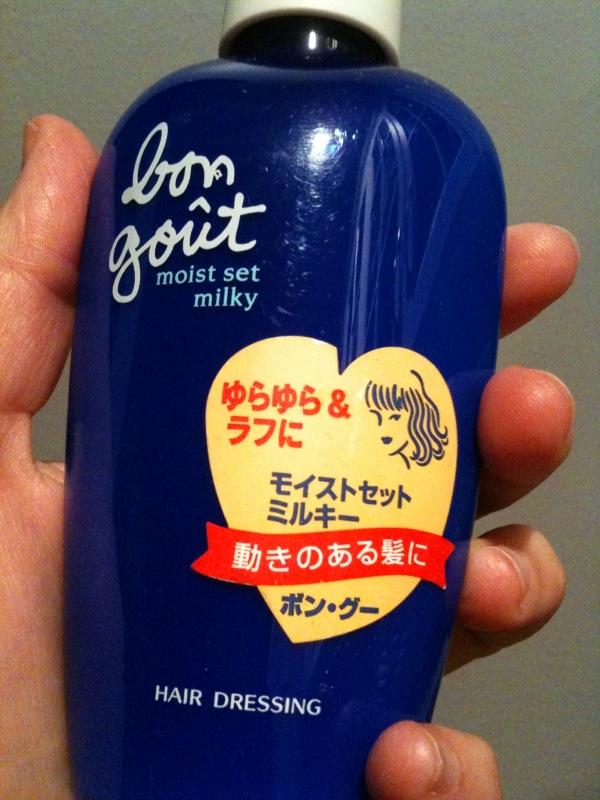
People either love this word or hate it. I love it because I think it really conveys that clammy quality.
Example: I shook his moist, limp hand, and instantly regretted it.

Egregious (adjective): extraordinary in some bad way; glaring; flagrant
The word just rolls off the tongue (or off the fingers, as the case may be).
Example: The professor wrote, “I will take off five points for each egregious error I find.”

Heinous (adjective): hateful; odious
Like egregious, it is just a good, all-purpose adjective to convey something unpleasant.
Example: Trish’s attitude swings from lovely to heinous — sometimes within minutes.

Beastly (adjective): nasty; unpleasant; disagreeable
See “egregious” and “heinous.”
Example: The humidity in Savannah is quite beastly in August.

Harass (verb): to disturb persistently; pester
Up until recently, this word was pronounced “HAIR-uhs” (and still is in many places). Here in America, we commonly say “huh-RASS,” which I like better because it is stronger (and I get to say “ass”).
Example: “Gideon, stop harassing the dog!” Eddie said.

Jackass (noun): a contemptibly foolish or stupid person
Speaking of ass, “jackass” is also a great word. It is strong, succinct, and also employs the word “ass.”
Example: People who leave anonymous comments on blogs are just jackasses.

Badger (verb): to harass
It is just such a great, descriptive verb.
Example: Dominic would not stop badgering his mother about his Batman suit.

Meh (interjection): expression of apathy or indifference
Nothing says indifference quite like “meh.” Just ask students in my classes.
Example: She asked, “Professor, how do you feel about my paper topic?” “Meh,” I replied.


Rascal (noun): a mischievous person or animal
I think I might have stolen this word from Eddie. I’m a rascal.
Example: Eddie looked at our wedding picture and said, “Who’s that handsome rascal?”
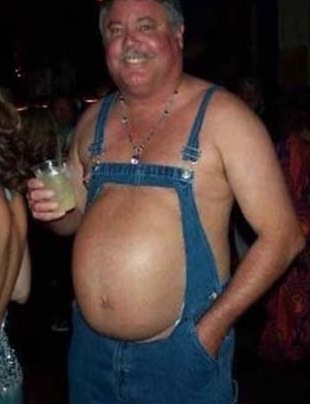

Hillbilly (noun): a person from a backwoods or other remote area
The word conjures up so many fantastic images.
Example: Effingham County is populated with hillbillies; Chatham County is populated with hillbillies who have money.

I see a theme here. I promise I also like words that convey positive things. But that is for another post.
Read Full Post »

Shane Marshall Brown, He Who Has Three Names, sent to me a link to a New York Times article about self-appointed Twitter scolds. I love it.

Even though I usually give people a pass for Facebook and Twitter, I’m happy to see others carrying the torch for proper grammar and punctuation.

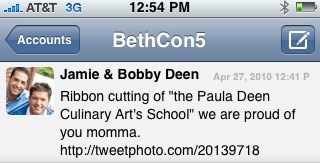
I wonder if they noticed the Deen Brothers’ tweet with the incorrect apostrophe:

Meanwhile, I’m still busy with loathsome words such as “partner.” Here it is, offending me from behind a glass enclosure at Memorial Health University Medical Center.

Why can’t they just join Memorial? Or be listed as co-sponsors? Or just have the logos without text? Sigh.

Read Full Post »

I have a friend, He Who Shall Not Be Named, who enjoys pointing out every mistake I make on Facebook or in this blog. What? You say you are surprised I make mistakes? Oh it is true.

I often make mistakes when my iPhone is involved. It is the spell check feature trying to be helpful. “Thing” turns into “think,” and “the” turns into “Tje” (whatever that means). If I don’t use it, though, “Heidi” becomes “Gefidi.”

I’m not making excuses. Like everyone else, I need to proofread. When I can, I have someone else proofread my work. It is almost impossible to catch all mistakes in your own work by yourself.

It may come as another surprise to learn that I cut people slack in text messages and on Twitter and Facebook. I know people are usually entering status updates on their phones, and may only have a few minutes of attention to spare.

But I often point out (and make fun of) mistakes in the wild, such as ones on signs, fliers, menus, etc., because people have spent money and/or time and effort to create something permanent.

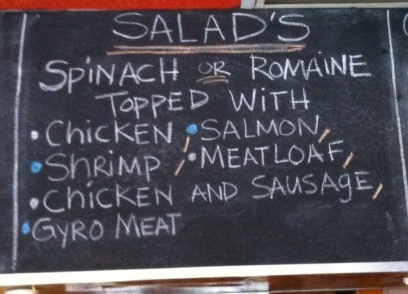
For example, I love Zunzi’s because the food is fantastic. I don’t like to look at the menu because it makes me want to scream.

What is the salad possessing (besides an apostrophe that shouldn’t be there)?

So He Who Shall Not Be Named, you had a typo in one of your Facebook comments this morning. I didn’t point it out. But if you ever make a mistake on a sign or menu, I’m on it like fur on a weasel.

Read Full Post »

As soon as I posted the list of the top five words I hate, I knew I would have a sequel. Here are five more words/phrases:

In order to
Like “currently,” this is unnecessary. “To” works just as well by itself.
Incorrect: In order to get his yard work done, Eddie had to take off a day of work.
Correct: Eddie had to take a vacation day to finish the yard work.

Piqued
I don’t hate this word. I hate that people don’t know how to use it correctly. People often spell it “peaked” or “peeked.” But it is a French word derived from “piquer,” which means “to prick.”
Incorrect: A student peaked my interest in peopleofwalmart.com
Correct: A student also piqued my curiosity about textsfromlastnight.com.

Hors d’oeuvres
This is another French word that I like when used correctly. The trouble is that people want to use it, but don’t know how to spell. It means “out of the main work,” and refers to appetizers. People mangle the “oeuvre” in a variety of ways, including “ourve.” One enterprising student wrote it “orderves.” Either write “appetizers” or look it up.

Biweekly
Is it every two weeks or twice a week? “Biweekly” can mean either. I hate the ambiguity. AP Style uses “biweekly” to mean “every other week,” and “semiweekly” to mean “twice a week.” But not everyone uses it that way. So let’s be specific.
Incorrect: He updated his blog biweekly.
Correct: He only updated his blog every other week.

PIN number
“PIN” stands for “personal identification number,” so “PIN number” would mean “personal identification number number.” And that’s silly. Same with “VIN number” (vehicle identification number number) and “UPC code” (universal product code code).
Incorrect: Give me your PIN number so I can steal your money.
Correct: “Give me your PIN,” I said.

I’m probably not done yet with the “words I hate” topic. People subject English to so much butchering.

Read Full Post »

Some students in my classes have asked for a list of words I hate. Here are the ones that are always at the top:

Currently

If there is a verb in the sentence, then you don’t need that adverb. It is redundant.

Incorrect: Beth is currently a writing professor. “Is” means it is happening right now. “Currently” is overkill.

Correct: I can’t think of an occasion where you would need it.

Hopefully

This is one of the most misused words in the English language. People use it to mean “I hope.” If that is what you mean, then use, “I hope,” for Pete’s sake! It is an adverb, which means it needs to modify a verb.

Incorrect: Hopefully, the envelope contains a bonus check. How is the envelope behaving in a hopeful manner?

Correct: She looked hopefully at the envelope, convinced that it contained a bonus check.

Utilize

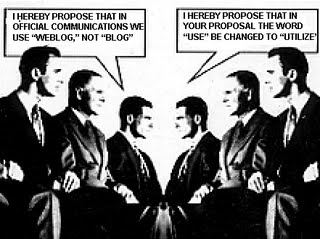
I’ve mentioned it before, but it bears repeating: There is nothing wrong with the word “use.”

Incorrect: Utilize your knowledge of grammar to start a blog.

Correct: Use your knowledge of grammar to start a blog. See? “Use” is a perfectly good word.

Nauseous

People use this word to mean “I am sick to my stomach.” But what they should say is “nauseated” because that is what they are. If they are nauseous, then they cause nausea in others.

Incorrect: “I’m nauseous now,” said Eddie after riding The Flying Critter at the fair.

Correct: “The Flying Critter made me nauseated,” he said.

Partner

This is a noun, not a verb. Stop trying to “partner” with people, and just team up, join them or just combine completely in the sentence.

Incorrect: The SCAD writing department is partnering with the graduate studies department to present a lecture by Rebecca Skloot.

Correct: The writing and graduate studies departments are sponsoring the lecture.

There’s more, but this list has made me nauseated, and I need to lie down.

Read Full Post »

An AP abuse alarm

A news organization’s improper use of AP Style is apparently enough to get me out of bed earlier than planned.

I checked my iPhone when I woke up, as is my habit, and found this:

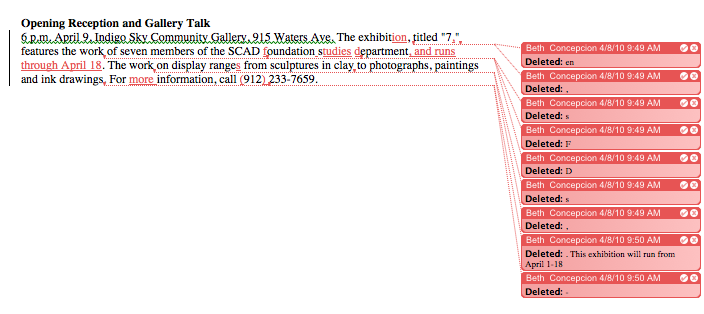
It is from the Savannah Morning News, of course. And the person who posted it on the Web probably just cut and pasted from a press release. But that person should have copy edited the entry (and the person who wrote the release also should use AP Style, as it is what media folks use). Here is what I would have done:

As I’ve said before, the Web deserves copy editing too.

Read Full Post »

I just read a newsletter that featured the word “complementary” (an accompaniment) when the writer really meant “complimentary” (free or offering praise). Many people have a problem with those words, and other homonyms. So let me explain.

Homonym: umbrella category for words that sound the same or are spelled the same.

Fuzzy Wuzzy (Wuz a Bear)Homograph: words that are spelled the same and sometimes sound the same, but have different meanings

Examples: bear (to carry)/bear (Fuzzy Wuzzy)  and wind (air)/wind (crank)

Homophone: words that sound the same, may be spelled the same, but have different meanings

Examples: they’re/their/there and you’re/your and bear/bear from above. Bear/bear is a homophone and a homograph.

Easy way to remember:

HOMO (same) + PHONE (sound) and HOMO (same) + GRAPH (writing)

OK, now it might get confusing. Also under the homonym umbrella are heteronym and heterograph.

Heteronym: words that are spelled the same, but have different pronunciations and meanings. Notice this is the same definition as “homograph.” “Heteronym” is a subset of “homograph,” which is a subset of “homonym.” Heteronyms are always pronounced differently.

Example: wind (air)/wind (crank) — this is both a homograph and a heteronym

Heterograph: pronounced the same, but spelled differently. Notice this is the same definition as “homophone.””Heterograph” is a subset of “homophone,” which is a subset of “homonym.” Heterographs always have different spellings and meanings.

Example: you (gentle reader)/ewe (lady sheep) and bare (nekkid)/bear (aforementioned Fuzzy).

Luckily, there is no such thing as a heterophone to confuse the matter any further.

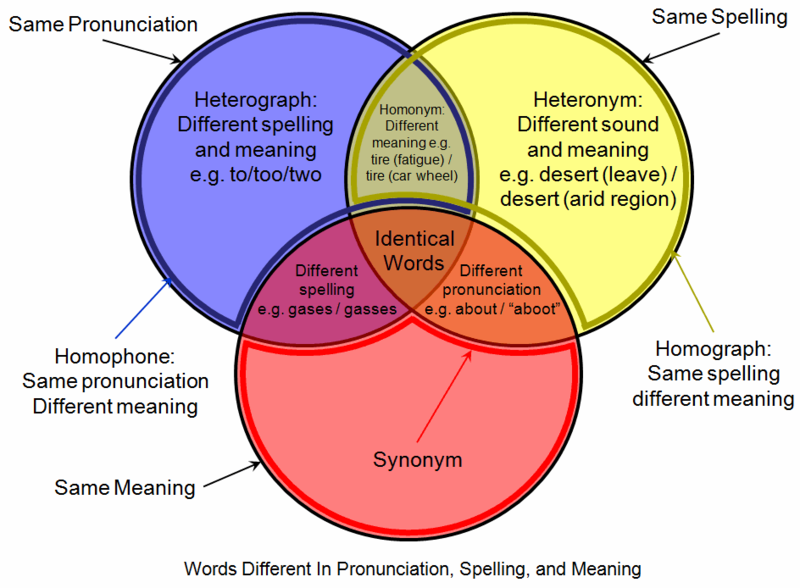
Here’s a Venn diagram of the above for you visual folks.

Venn diagram by Will Heltsley

The only problem is that the diagram makes it look like homonyms are only words that are both homophones and homographs. Homonyms are really the whole shebang.

And that’s different from “ad hominem,” which is a logical fallacy that is an argument against a person.

Sigh.

Read Full Post »

I know I just wrote a new post, but then Caila, SCAD Radio‘s general manager, shared this with me:

Full link here.

Forget that the writer clearly doesn’t know AP Style. She has bigger issues. Evidence: the very first sentence. I’m guessing she meant “descend” not “decent.”

But wait, there’s more. Gaze upon this section:

So let’s help her out on the big ones:

  • “dies” should be “dyes”
  • “chanel” should be “channel”
  • “affect” should be “effect”

I love the “rumor vs. reality” theme, and I like her voice. What I don’t like, of course, is that it is riddled with mistakes she should have caught. And I’m guessing Savannah Morning News writers post directly to the Web without benefit of a copy editor’s glance.

SIGH.

Read Full Post »

So I’m on high alert for interesting signs now. My friends know this, and have shared some spectacular ones. This is the one everyone sent me this week:

Nope. Still not right.

Near “South of the Border” (!) I discovered a place with a treasure trove of fireworks. The labels are amazing. Check it out:

Perfect for St. Patrick's Day

There’s nothing grammatically wrong, but I’m not sure I like the idea of flaming balls.

Read Full Post »

A doozy

This sign defies explanation. Please gaze upon its hideousness, while I cluck in dismay.

Read Full Post »

« Newer Posts - Older Posts »