Feeds:
Posts
Comments

Posts Tagged ‘Bureaucrats’

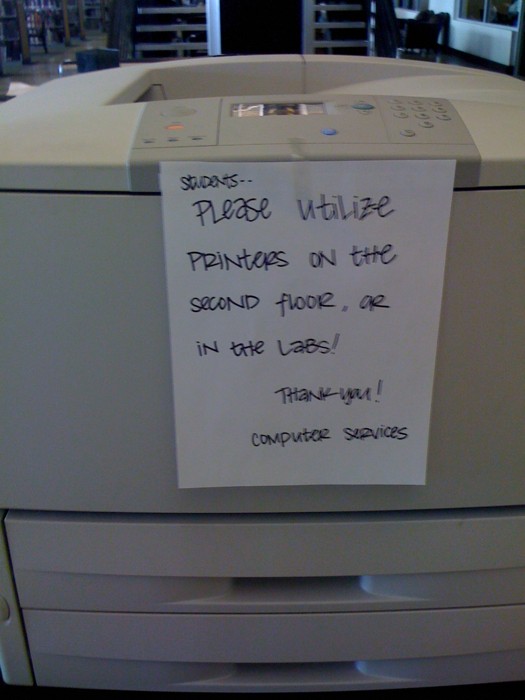
Today’s topic and photo are courtesy of Travis, a student in the SCAD writing department. He discovered this sign on a printer in the Jen Library. Some students say it has been there for a couple of weeks.

Here’s my beef with this sign: the word “utilize.” What did the word “use” ever do to anyone? “Utilize” is like pearls on a pig. Pointless. “Use” is a fine word; there is nothing wrong with it. That’ll do, Pig. That’ll do.

And don’t get me started on “supersize” as a verb. Damn you, McDonald’s.

Read Full Post »

In 2005, when SCAD was considering offering a writing major, I thought to myself, “Self, it would be great to teach in that department.” Though I had oodles of work experience, I knew that SCAD’s accrediting body prefers terminal degrees in the field of instruction. So I had two choices: Get another M.F.A. (the one I have is in performing arts) or get a Ph.D. I chose the latter.

I had three criteria in mind as I researched programs: areas of study offered (journalism or communications), proximity and reputation. The one that fulfilled all these requirements was University of South Carolina.

Eddie badgered me to apply. “But that would require taking the GRE!” I whined. “And I’m pregnant!”

“So?” he said, with very little compassion, I might add.

Lest you think he is heartless, his philosophy was that I might as well get on it while the kids were very young. That way I would be done when they got old enough to start extracurricular activities that I wouldn’t want to miss.

I knew he was right. I forced myself to take the GRE and apply to the doctoral program in the USC School of Journalism and Mass Communications. I was accepted, and began coursework Fall 2006. The total courses involved for most folks: 16 (48 semester hours). For me: 18 (because my master’s is not in the specific area).

I finished the coursework in April 2009. I spent the summer procrastinating on my dissertation proposal, and dreading the comprehensive exams (four days, three hours a day of answering questions in four areas: theory, methods, ethics and rhetoric, which is my outside area). I passed the foreign language proficiency test in October (see related post). The comps dread continued.

The time came, though, for me to put up or shut up. I studied my haunches off in preparation for the comps, which I stupidly scheduled for the week after Thanksgiving. The 19 people in my house for the holiday might not have fully understood why I was so stressed out.

Along with the written comps, there is an oral defense. That happened today. After my committee slowly roasted me over an open fire for two hours, they decreed that I had passed. To be honest, the first 20 minutes were horrendous, but then the rest was fine. The discussion will help me hone my dissertation proposal, for sure.

And that is the next step. I defend said proposal in front of my committee Feb. 19. Once I pass (the power of positive thinking), I will work exclusively on my own research for my dissertation. Then I will have to defend my dissertation in front of the same committee. Thumbs up, and my hooding awaits. Thumbs down, and … well, that’s really not an option for me.

So if I look a little frazzled in February (and over the summer), you’ll know why.

Read Full Post »
I rarely read for fun anymore because I don’t have time. People, Newsweek and Entertainment Weekly are my only sources of reading enjoyment. Sad, I know.

While I was in Barnes & Noble buying a book for research, I decided to buy “Columbine” by Dave Cullen because I had heard so many good things about it. I devoured it in less than 24 hours (kind of a long time for me, actually, but I had two vocal distractions and a “Survivor” finale to watch).

It is an impressively researched and incredibly interesting book. I remember the shootings, but was, like most, misled by erroneous and perpetuated media accounts into believing Eric Harris and Dylan Klebold were outcasts who were being bullied. Instead, Cullen makes clear, they often did the bullying, and they had few close friends by choice. At least that was Eric’s choice. He was a true psychopath, the clinical definition. Dylan was depressed, lonely and incredibly shy.

One of the concepts I teach is crisis communication. The Jefferson County sheriff and his office did almost everything wrong. Repeatedly. But, if nothing else, communicators can learn from their mistakes.

The overall feeling I have after reading the book is sadness — sadness for the victims and their families, of course, but they have long had support in their recovery and grief. I feel the most sadness for Tom and Sue Klebold and Wayne and Kathy Harris. It is easy to point the finger of “bad parenting” at them, but there is no “if/then” manual for parents. You have to do the best you can. It is hard to distinguish the difference between warning signs and normal teenage angst. And no one wants to think his/her child is a psychopath. They also lost their children on April 20, 1999, but their children were killers, which adds another layer of pain. They also lost community support and relationships. They were vilified unjustly.

In general, the book is a solid piece of reporting. I do wonder why he chose to focus on the stories of a few of the victims, but not all. Some are not even mentioned. Also, Cullen could have used a diagram of the building and images of the people he discusses, but perhaps he thought the images would sensationalize the story even more than it has been. But I wanted to be able to visualize whom he was discussing. I turned to the Internet, of course. The bullying myth is still rampant in the comments on the videos. I wanted to respond to all of them. Sigh. Maybe word will get around thanks to Cullen.

Now I’m off to play with the kids, and hope that one of them does not grow up to be infamous.

Read Full Post »

The University of South Carolina requires proficiency in a “foreign” language for those who wish to pursue a Ph.D. It isn’t like we have to use it in our research, but it exists among the many requirements for the doctoral degree.

In April, I decided to get the language proficiency exam out of the way. I speak Spanish with Eddie and his family, so I wasn’t particularly worried. That attitude cost me dearly.

What I assumed would be a conversational Spanish exam turned out to be a translation nightmare from the bowels of Hell: Translate in one hour a 500-word passage about the history of journalism from the time of Julius Caesar. Um, I don’t usually talk about the “foro romano” with my mother-in-law. What is worse is that I only had a very wee Spanish-English dictionary. So that didn’t go well.

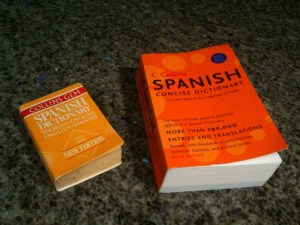
Later I found out it is a scam. They want you to fail so that you have to pay for and pass the class. On principle, I refused to take the class. Instead, I bought a larger dictionary and vowed vengeance.

Spanish-English dictionaries

Before (left) and after (right)

I took the exam again on Oct. 21. Though I had studied up on my Roman history in preparation, they had a new passage for me to translate. It was a forward to a contemporary collection of essays about journalism. I breezed right on through.

Today I received notice in a mass e-mail that I passed:

Recipients  of this message  have PASSED the Spanish Reading Exam. Congratulations.  Please respond  to this e-mail to acknowledge receipt of this mail and include again the name of the faculty member to whom I should send the letter for your file.

Y había mucho júbilo.

Read Full Post »

Passive voice bothers me and sucks the life out of material. Academics, politicians and other bureaucrats LOVE passive voice. My students seem to like it too. At least that’s what their papers indicate.

Examples:

“As Americans, we tend to be frowned upon.”

“A new collection of her nonfiction has just been released.”

Just say WHO did/does/is doing WHAT, and say it first:

“French people tend to frown upon Americans visiting Paris.”

“Random House just released a new collection of Toni Morrison’s nonfiction work.”

I like this page because it offers more examples and advice, and has a quiz. Doesn’t everyone like a quiz?

Read Full Post »

« Newer Posts