Feeds:
Posts
Comments

Posts Tagged ‘Definitions’

My transformation is now complete. I am now part of the “Mom” species. Yes, I know I have two kids and have been a mom for a while. But this week, I became a Mom with a capital M.

One of my students said about me, “She is like the cool mom.” And that aged me 10 years.

Then Dominic started soccer practice. And that added 10 more. I’m a freakin’ Soccer Mom. Feeling middle-aged and frumpy. How did this happen?

Soon, I’ll be shopping at JCPenney for Mom jeans. Thanks to SNL, I can show you what I mean.

The good news is that the boys love soccer. I’m happy because they’ll learn teamwork and get some exercise. Too bad the sand gnats like soccer practice too.

Dominic (blue shorts) learns fundamentals

Gideon's got mad skillz

Read Full Post »

I love the show “Hoarders.” I hate the written chunks between segments. Not only are they unnecessary recaps, but they usually feature passive voice. I hate passive voice.

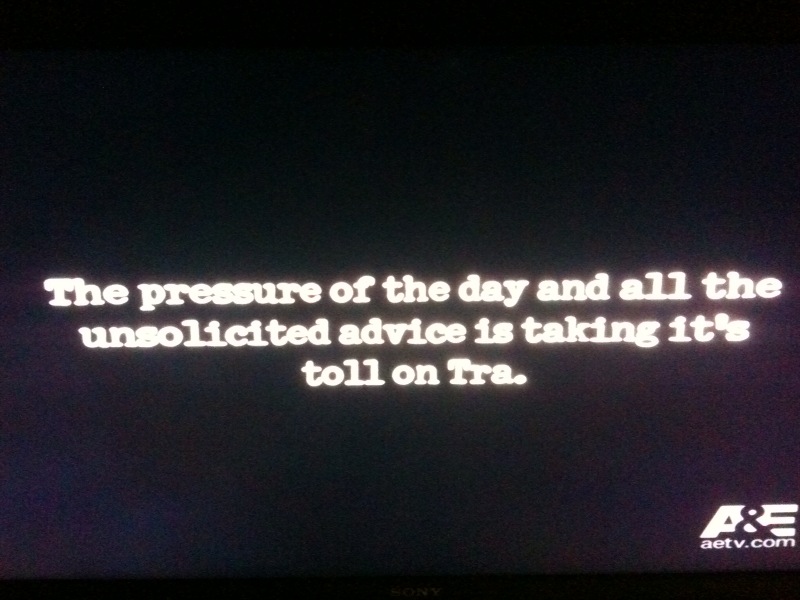
On the last episode, I was shocked to discover something I hate even more: an egregious error. Take a look:

"Hoarders" error

Despite how people may want this to work, and expect it to work, the possessive form of “it” is “its.” No apostrophe. “It’s” is always a contraction for “it is” or “it has.” Those are the rules.

To the “Hoarders” production crew, I say, “Please stop hoarding apostrophes.”

Read Full Post »

Perhaps I wasn’t clear in my last post. At least, I wasn’t clear enough for new people visiting my blog from the Broadway discussion board. And for that, I apologize.

As “jmi” points out: “She didn’t really say anything in the blog other than that her friend found this thread. What’s interesting about that? We all found this thread too. ;-)”

Yes, indeed.

Here is why I posted the link to the thread on my blog:

1. Because I love it when people have in-depth discussions about grammar, punctuation and style

2. Because “gusto” posted (with gusto) that he/she had the only correct answer (“These are the rules”), when he/she was quite wrong according to a number of stylebooks. My favorite, the AP Stylebook, allows only quotation marks for composition titles.

3. Because Shane Marshall Brown saw the thread and thought of me. I love that people think of me when they see language mistakes or language discussions.

So thank you, “jmi,” for reminding me of the importance of considering my audience.

Read Full Post »

Today’s post topic comes from my good friend Shane Marshall Brown. (He has one of those names where you just have to say the whole thing — like Jonathan Taylor Thomas, Anthony Michael Hall or Billy Bob Thornton. I’ve never referred to him as “Shane.” That would be weird.)

Anyway, he is a publicist for Broadway and off-Broadway shows, and discovered this thread about the show “ENRON.” My favorite part is the post where “gusto” asserts, “These are the rules.” It is a good thing “FleetStreetBarber” was there, or I would have had an AP canary all over that thread.

It is also a good thing I have this blog as a place to vent.

Read Full Post »

Thanks to my friend Heidi, I am now wearing my mascara in a variety of places. She directed me to a site that has me weeping: http://engrishfunny.com/

Here is a sample of what you will see on this site:

Enjoy!

Update: Here is a similar site, courtesy of my friend Billy: http://engrish.com/

Read Full Post »

I kept it together tonight. I did not throw my panties on the stage, or engage in any other unseemly fan behavior. I was, however, awestruck, and rendered speechless.

Stanley Fish spoke at SCAD.

The topic of his lecture was “How to Write a Sentence.” If you read his New York Times columns here (Part I) and here (Part II), you’ll get the gist of the lecture. Bottom line: Form is more important than content. People can express ideas and be creative only within the confines of syntax, and they must know syntax.

Now discuss among yourselves. I feel faint.

Read Full Post »

No one really asked for more rhetorical devices, but I’m on a roll. Here are four more of my favorites:

To use metallage (“Meh-TALL-uh-gee”) is to use a word or phrase as an object in a sentence. I’m going to go all “Pulp Fiction” on you and mention that scene with the Gimp. Marcellus Wallace (Ving Rhames) says, “You hear me talkin’, hillbilly boy? I ain’t through with you by a damn sight. I’ma get medieval on your ass.”

In that same vein, periphrasis (“Per-IF-ruh-sis”) uses a description as a name. Think Harry Potter and “He Who Shall Not Be Named.” And I’d better not hear Eddie refer to me as “The Old Ball and Chain.” Or “Fat Ass,” for that matter.

Two more devices — metonymy and synecdoche — seem to be difficult for many people to understand, and there are plenty who say they are the same. They are not.

Metonymy (“Meh-TAH-no-mee”) refers to describing something indirectly by using similar items. For example, you can say “the deep” when you are talking about the ocean.

Synecdoche (“Sin-ECK-doh-key”) swaps a thing for a collection of things, or a part for a whole. For example, the bank foreclosed on our neighbor’s house. The representatives of the bank did it, but it is easier to say “the bank.”

The difference between metonymy and synecdoche is this: When A is used to refer to B, it is a synecdoche if A is a component of B, and a metonym if A is commonly associated with B but not actually part of its whole. Representatives are part of a bank, therefore it is synecdoche. But the ocean is deep (deep water is like an ocean), so it is metonymy.

Got it? Good, ’cause I don’t wanna go all medieval on you.

Read Full Post »

When last I blogged, I mentioned “litotes,” a rhetorical device that is similar to a double negative. This device, pronounced “LIE-tuh-teez,” allows someone to make a point by denying the opposite. For example, if I said, all regal-like, “We are not amused,” you would understand that all is not well, and that you should perhaps vacate the scene.

There are loads of other devices. As soon as I point them out, you’ll start seeing them everywhere.

Take, for example, chiasmus (“Kie-AZ-mus”), a sentence that presents a mirror image of a concept. I often say that I work to live, not live to work, even though I do love my job.

Perhaps the most well-known chiasmus came from John F. Kennedy in his 1961 inaugural address: “Ask not what your country can do for you, ask what you can do for your country.”

Two other devices are similar: antithesis and anadiplosis. Antithesis establishes a clear, contrasting relationship between ideas. For example, original moonwalker Neil Armstrong said of the 1969 landing: “One small step for [a] man, one giant leap for mankind.”

Some examples of antithesis are chiastic, but not all. And if it is chiastic, then just call it a chiasmus. Antithesis = general contrast; chiasmus = specific mirroring.

Anadiplosis (“Anna-di-PLOH-sis”) goes one step further by repeating the last/first structure, but it is not a mirror. In “Star Wars Episode I: The Phantom Menace” — a dreadful movie — Yoda said, “Fear is the path to the dark side. Fear leads to anger. Anger leads to hate. Hate leads to suffering.”

Do you want to know more about rhetorical devices? Of course you do. And asking and answering a question is called hypophora (“High-PAH-for-uh”).

Read Full Post »

"I don't know nothing 'bout birthin' babies!"

I don’t know nothing ’bout grammar. That’s good, because I write a grammar blog. (Well, grammar and other things.)

You might ask, “Whatchoo talkin’ ’bout Willis?”

That, my friends, is a double negative. What I really said was, “I know something about grammar.”

Pink Floyd sang, “We don’t need no education,” but what they were really saying was, “We do need education” (whether they wanted to or not). The “not” in the contraction cancels out the “no,” resulting in a positive statement.

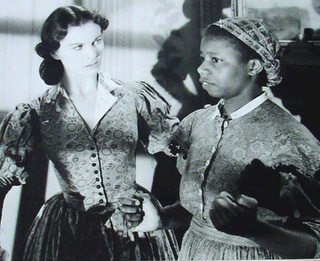
Usually people use the construction to indicate the opposite, though, like Prissy (Butterfly McQueen) in “Gone with the Wind“: “I don’t know nothing ’bout birthin’ babies!”

So Miss Scarlett was in luck. Yet she wasn’t. You see?

Similar to this concept is a rhetorical device called “litotes.” I’ll tackle that topic in an upcoming post.

Read Full Post »

It’s been a while since I’ve tackled a grammar issue, so here is a big one: when to use “I” and “me.”

I had to stop reading one friend’s blog because she misused “I” so many times.

Here’s the deal: “I” is a subject pronoun and “me” is an object pronoun. So, “You and I should go Christmas shopping” because “you and I” are subjects doing something. And, “Santa hit on you and me” because Santa is doing something to us.

It is not OK, ever, to say “Santa gave his number to you and I.”

Need a hint? Take out the other pronoun and see if it works. “Santa gave his number to I” is not correct.

And it is always “between you and me,” no matter what you hear in songs such as Jessica Simpson’s “Between you and I” — not that you are really listening to that, of course.

Read Full Post »

« Newer Posts - Older Posts »